I have been deciding what measurements to include on my measuring jug, thus far I have decided on imperial one side and metric the other. I want to make the jug functional, yet I do not want to compromise the element of volume perception. I have been thinking of how the product will be packaged, so did some screen printing today using brown card and white ink. To subtlety indicate the origins of each measuring system, the font for the metric side is Letter Gothic Standard and the imperial side is Lucinda Fax. I think the simple graphic works well but perhaps adding measurement markings would be clearer, but for an initial design I am pleased with it. I want to stay clear of red markings as I feel it references pyrex too much, instead I intend to use a pale grey, which is discreet, yet visible when using liquids such as milk. For next week I intend to have finished my CAD drawing, along with render, ready to send to manufacturers in order to get a quote. I would ideally like to prototype a small batch, of ten or so as I really want to communicate that this product is fit for retail.
Documentation of my process of research led design, with the final outcome of an appropriate batch produced product.
About Me
- Laura Nelson
- Product and Furniture Designer. Currently studying at Kingston University London.
Thursday, 22 March 2012
Wednesday, 14 March 2012
Picking up where I left off
I have been working on my dissertation and major project since Christmas, so have not done much on this project, but it has been in the back of my mind. Since this time I have still been accumulating measuring devices and vessels with reference to measure as I aim to create a book of measures to show my research and investigations into the perception of measure and how it has developed. Last Thursday I began drawing the jug on CAD, and started sketching possible measure styles, ranging form just lines describing one quarter, a half and 3 quarters o f a pint, along with these measures translated in millilitres. Because the object is so simple I aim to keep its intention really obvious, whilst still maintaining an element of accuracy through functionality. My next step is to finish my CAD drawing in order to send to manufacturers to get an idea of costing and lead times. Along with designing the packaging.
Friday, 16 December 2011
No longer a family of objects
Week 6
Due to the vast amount of research I have done for this project, the only option to communicate it all has seemed to be a family of objects. However from the final crit a couple of days ago, the decision has been made to solely carry on with the pint jug, which may perhaps lead to other vessels? And use the other areas of focus for exploration of volume. I feel it is important to still include these areas as it has informed my decision making and reasons for doing certain things. I aim to create some kind of visual representation of my findings, perhaps in the form of a book to accompany the Pint jug.
I feel more confident now about my idea, I would much prefer to create one strong object fit for retail, as opposed to 3 or 4 weaker objects. I value the research I have done for this project and feel it will definitely inform future work, perhaps in our second project where my area of focus is hand held appliances.
The frustrating thing about this is the inability to be able to work with the glass myself, the slumping technique I have been using works to an extent, however due to being unable to cool at a steady pace it inevitably cracks.
I will look into getting this prototyped; perhaps through lampworking as the current method of manufacture for pint glasses is press and blow molding and is on a mass scale of around 400000 units.
The other areas I looked at were looking at the existing as forms of measure through bottle caps. An idea that came from ambiguous measures such as a splash and a dash and how the cap could offer a dual function.
I also was experimenting with different proportions of the same volume in order to get people to question and understand amounts more. This I feel is an exercise that could be ongoing and could feature in the visual piece to accompany the pint jug, through creating 5 alternative forms of packaging for 200, 330ml and so on.
I feel the project is now at a good place I know what needs to be done and it has direction, so a break from it to concentrate on my dissertation and forthcoming project seems wise.
Wednesday, 7 December 2011
The familiar, informal measure, empowerment and proportion
Week 5
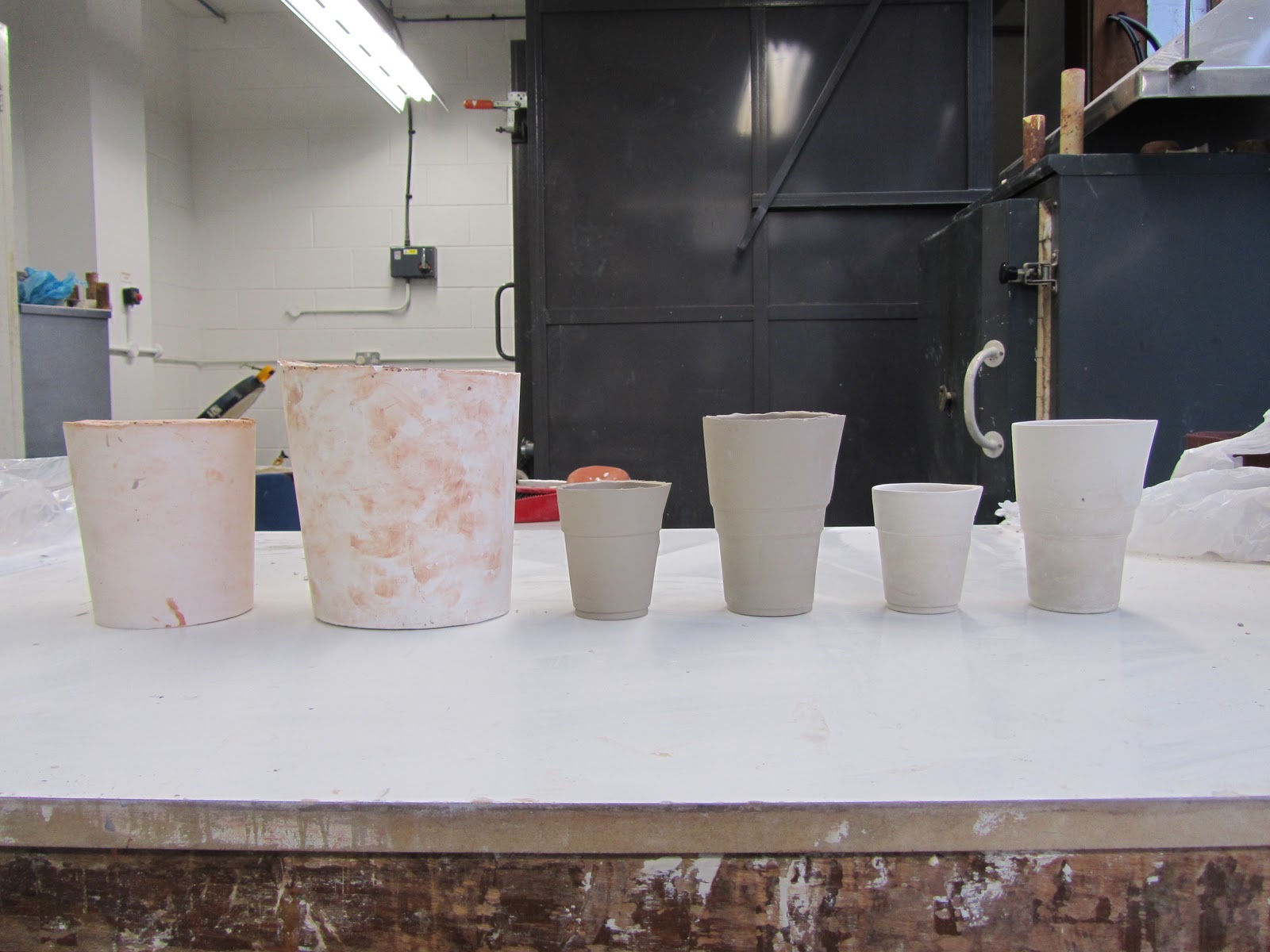
For the past week I have been slip casting the familiar form of the disposable pint glass. It has been interesting as I have learnt a new process, and it has given me a really literal understanding of the form I am working with and the notions of volume. I have expressed this in relation to one of the four areas in which I aim to create a family of objects:
The familiar:
How we associate measure with certain things, looking literally at different forms and the similarities they share. Executed by exploiting the obvious as a means of understanding.
I really like the result of the ceramic cups and the process is very rewarding. However; despite this this I have came to the conclusion that glass would be a more suitable material for the pint measuring jug I am trying to create. For the prototype I am to deliver next week, I will slump another pint glass and sand blast subtle markings in order to create a familiar yet alternative to the typical measuring jug.
I have become slightly obsessed with slip casting and the pint form, however I aim to finish that today and move on to the other areas I have defined. Another area I aim to look at is; iinformal measure:
Using the idea of approximation and guesswork as defined through human dimension using natural units to create tools. This offers more freedom and allows the user to instinctively measure and build confidence.
I want to create a product that encourages the use of the human body as a unit for measure; as it has become de humanized, a theme that has re occurred throughout this process. I aim to look at methods of measure by observing behavior and analyzing current methods of measure.
Empowerment:
Making consumers more confident, by using their surroundings as a tool. Enabling people to look at measure in a less regimented way through the use of existing forms, therefore taking the familiar and creating a dual function. This relates to my previous research of association, for example 1kg=a bag of sugar. Using everyday items, as a form of measure is really interesting and dates back to the 18th century. From looking at a cookery book called; the art of cookery, made plain and easy: which far exceeds any thing of the kind yet published... by Hannah Glass. A revolutionary cookery book, which deals with wholesome British food. Interestingly one of the methods of measure is, ‘the amount of shredded parsley and sage that will fit on one sixpence’. I just find this so fascinating, how currency was used as it has a nationally uniform size, yet is unhygienic. I want to create a product with a similar principle that we relate to in current society, this may well be achieved by appropriating the existing.
Proportion
Observing what we understand volume or measure to be through different shapes as a means of educating people. Allowing them to trust their judgment more. This exercise started back with packaging, it could be a marketing led product designed to be a catalyst for change and awareness. I will continue to experiment with this through looking at packaging and making alterations through models. Then obtaining peoples opinions of the results.
Key themes that link this family of objects:
Products that provide a relationship between the user and task in hand
What I want to achieve:
Human informed tools/products
Subconscious methods of education
Products that blend into the everyday
A strategy for change; that may perhaps inform my future project, in terms of:
Efficiency
Waste
Value
In the next week I aim to finish my prototype of the glass jug and have a good idea of the costing criteria. I then intend to develop each of the other areas more through research led investigation and model making.
Friday, 2 December 2011
Amounts in relation to the existing
Week 4
Following on from last week I have been experimenting with volume looking at pints and litres. The models I created look at proportion along with how we perceive and interpret volume. The various different forms, made those around me re think volume. The forms are based on simple 3D structures commonly found in physics or mathematics, informed from my research in the science museum.
This led me to look at environments where weight and volume are prominent, a bar and kitchen. Chef, Rene enlightened me by talking me through a couple of his recipes. He is polish and is accustomed to working with metric units, however when creating English recipes has to translate this into imperial. This leaves figures such as 667grams, which would normally be rounded to the nearest 10 metrically.
I looked at what surrounds us and how we relate this to measure, such as packaging I looked at certain forms such as milk and juice cartons. I thought about taking the aesthetics of these containers and applying this to measuring devices, without being blatently obvious or crude.
From these experiments I established the clear theme of vessels, so decided to take familiar forms of pint gasses and turn them into measuring vessels. This was informed from looking at measuring jugs, as they are the volume of a pint. Through a familiar form, of the typical pint glass a sense of amount could perhaps be understood more easily. I did this by slumping the glass using a blowtorch. After a couple of cracked attempts, I managed to slump a subtle lip on the edge of a bubble pint glass. Unfortunately I dropped the glass and smashed it. But had another go with tumblers which worked, in a previous glassblowing project I did the same with a wine glass which had fluid results.
Following on from last week I have been experimenting with volume looking at pints and litres. The models I created look at proportion along with how we perceive and interpret volume. The various different forms, made those around me re think volume. The forms are based on simple 3D structures commonly found in physics or mathematics, informed from my research in the science museum.
This led me to look at environments where weight and volume are prominent, a bar and kitchen. Chef, Rene enlightened me by talking me through a couple of his recipes. He is polish and is accustomed to working with metric units, however when creating English recipes has to translate this into imperial. This leaves figures such as 667grams, which would normally be rounded to the nearest 10 metrically.
Alot of ratios are used especially in baking, and ingredients are added in a consecutive in one bowl. Rene raised an interesting point, of using taste as a method of assessment, a very human form of measure. Seasonal factors often determine recipes, eg. when strawberries are in season. Therefore more or less need to be added, depending on sweetness.
The method of measure Rene uses for hollandaise sauce is a soup ladle, which he uses as a method of ratio for each ingredient. He briefly mentioned the American measuring system of cups, he described as;
‘Simple, yet unreliable, under or over measured’.
I then observed human behaviour of making tea and coffee, the amounts of water required, and through habit how much you need to overfill of under fill with regards to milk and water. After baking cakes I noticed a really visually clear method of measure as part of butter packaging. I think it is informative as it involves interaction with the butter, through the act of slicing.
I experimented with the same volume of liquid but in different vessels. This showed similar results to the exercise with 3D volume models, and illustrated how we associate volume with certain vessels. When filling the vessels to equal a small glass of wine, I was unable to measure the quantity using just the ml markings so subconsciously referred to the imperial side.
I looked at what surrounds us and how we relate this to measure, such as packaging I looked at certain forms such as milk and juice cartons. I thought about taking the aesthetics of these containers and applying this to measuring devices, without being blatently obvious or crude.
From these experiments I established the clear theme of vessels, so decided to take familiar forms of pint gasses and turn them into measuring vessels. This was informed from looking at measuring jugs, as they are the volume of a pint. Through a familiar form, of the typical pint glass a sense of amount could perhaps be understood more easily. I did this by slumping the glass using a blowtorch. After a couple of cracked attempts, I managed to slump a subtle lip on the edge of a bubble pint glass. Unfortunately I dropped the glass and smashed it. But had another go with tumblers which worked, in a previous glassblowing project I did the same with a wine glass which had fluid results.
I also created a pint jug from a disposable pint glass, which I intend to slip cast next week. I have started to do the same with a 20cl disposable glass.
Experimenting with forms and volume has really helped me to move forward and to focus on vessels. I intend to keep experimenting with different forms, materials and processes and assess each stage. I aim to create a family of objects that look at volume and weight through human perception.
Thursday, 24 November 2011
5 Areas
Week 3
From looking once again in more depth at measurements, I attempted to divide the research into 5 areas of;
Human Body
Topology
Scale and proportion
Regional vs standard
Socially related
Over the past week I think the project has progressed, yet the subject is still broad and overwhelming. To reach an outcome the areas must be focused in order to achieve concepts. I feel there is substance in the topic of volume and weight, as this relates to human behaviour and our perceptions of amount in relation to what is around us. Evolution of objects is a means of measuring the needs of society at certain times, which came from looking at topology. Therefore this considers the narrative element of an object and is related directly to the relationship we as humans form with it.
In order to prevent confusion I have decided to stop using the term measurement as the title for my topic and use the word amount instead. I will conduct experiments with volume through changing proportion, along with how we judge weight and volume. Evolution will be investigated through looking at current behaviour, that of the past and how this can be used to forcast the future.
I have found the human relationship with measure insightful and how it certain units have been developed for a reason. I feel we have lost an understanding of the products we use, perhaps this is due to standardisation and anonymous design. Through design we can subtly communicate with people in order to re establish understanding.
At the moment I have views on this topic yet the direction is still quite blurred, hopefully focusing on volume, weight and evolution will help to move the project along. I intend to look at domestic areas and observe human behaviour.
Thursday, 17 November 2011
Measurements in more depth
Week 2
From mapping my research, I have established common themes that link all my findings into six areas:
For the past week I have been continuing my research on the principle that measurements are derived from the human form and regionally. I have been reading an interesting book, Smoots Ear by Robert Tavernor, an architect and lecturer at London school of economics. A lot of the notions in the book highlight the resistance against standardization, particularly from the British with regards to the French dream of alliance through standardization. However the metric system could be described as intangible, in terms of relationship;
“Measure has been dehumanised, it has been reduced to a practical tool, deliberately stripped of human association.”
I decided to focus on different types of measure in order to research efficiently, I looked at length, weight, time, weather, force, sound, time and function specific measurements.
| Philosophical bubbles, Anthoni Marnoni 19th Century Float depending on density, determining strength |
From mapping my research, I have established common themes that link all my findings into six areas:
1. Human form
2. Regional
3. Algorithms and logarithms
4. Decimal base 10
5. Pythagoras ‘perfect numbers’ (1+2+3=6 1+2+3+4=10)
6. Socially related
Length is associated with the human form, inches feet and yards, along with proportion for example the Vitruvian man and how the body is divided into tenths. I also looked at the golden section and how it is applied to architecture. Along with calculating phiφ=1.618033988739895 through an equation.
![]() |
| Vitruvian man, Marcus Vitruvius Polio |
The French created the calendar based on national holidays, the first day of the year was Bastille Day on the 14th of July. Then in 1792 this was changed to the 1st of January in a bid ‘de-Christianise time.’
Weight varies from place to place and often, is related to the trade it is applied a goldsmith’s pound could be different to that of a baker. Decimal base 10 is apparent in the metric system and seems to be tangible as it associated with the easy, however time is sexagesimal and is easily divisible, corresponding with Pythagoras perfect numbers.
In relation to logarithms, it is how babies think of numbers, e.g. 8 and 16 have a relationship, 8 and 9 do not. A tribe in the Amazon rainforest still has this way of thinking, when asked what is between 1 and 9? Their response is 3 (3x3=9), where as we would assume it is 5. Susan Carey, a physicist from Harvard explains; "to gain knowledge you loose past thinking'.
From listening to a Radio lab podcast about cities, Geoffrey West a physicist has constructed a calculation that uses the walking beat of people in cities in order to gain data on the appropriate number of schools that should be in the area. This uses the human footfall as a measurement in an algorithm in relation to current society.
I am finding this topic highly interesting, there is vast amount of information to process and maintain, so I am continually summarizing information. I intend to have a glossary of measurement at the end of the project to visualize my findings and to help make them more understandable.
![]() |
| Example glossary page |
In the forthcoming week I intend to look at my finding in 3D forms such as models, in relation to scale, and experiment with such findings in order to apply my research. I will study existing products to establish alternative proportion methods. Equations and systems will be an area of study, which will help generate outcomes. The narrative and story telling element of measure will remain an interest as it reflects the culture of a time and represents society.
This will help to realise five insights based on the areas previously discussed.
Subscribe to:
Posts (Atom)